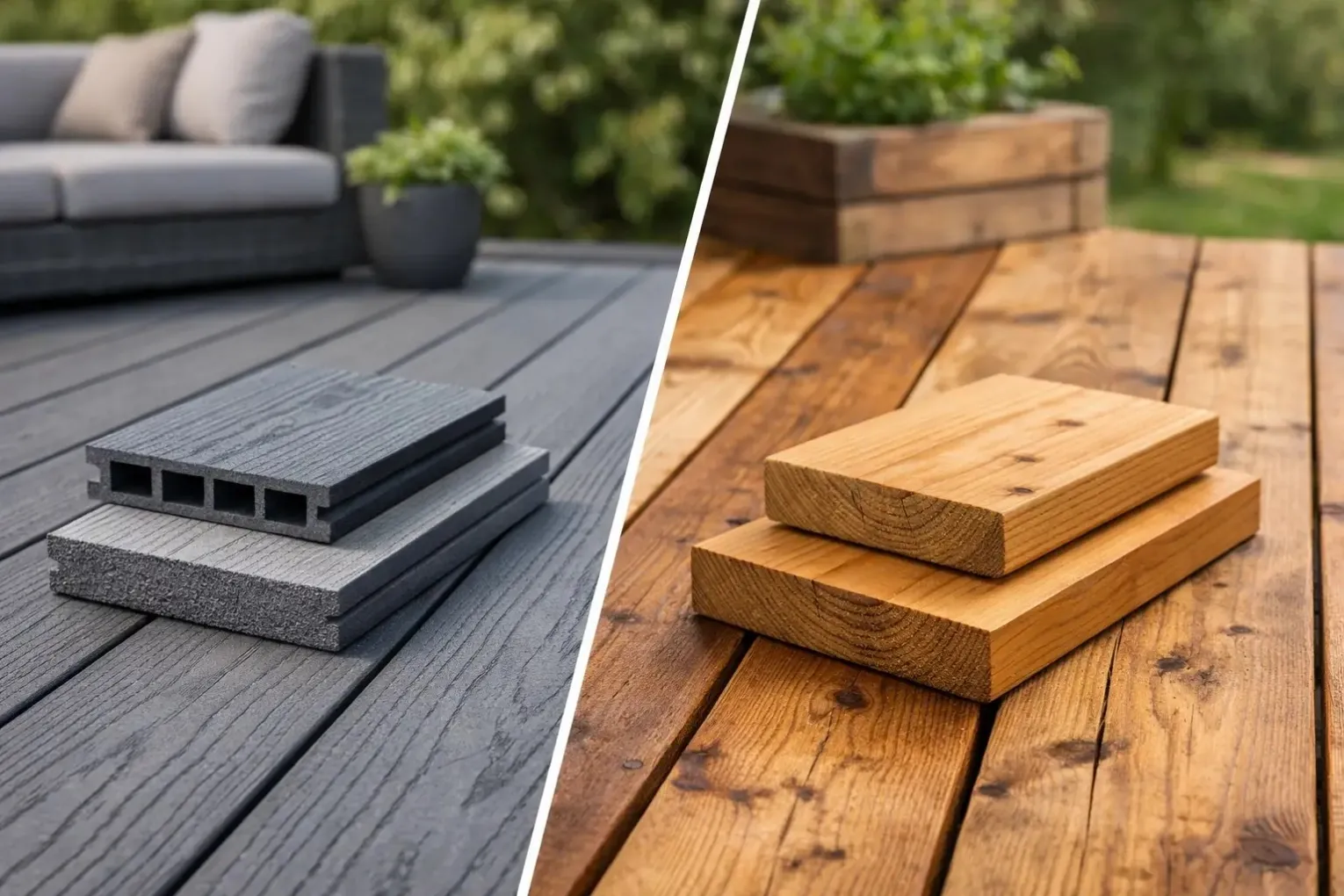
What Is Co-extrusion WPC Decking?
Co-extrusion WPC decking adds a co-extruded protective layer over a WPC core. This guide explains the construction and the key factors buyers should consider when selecting a decking profile.
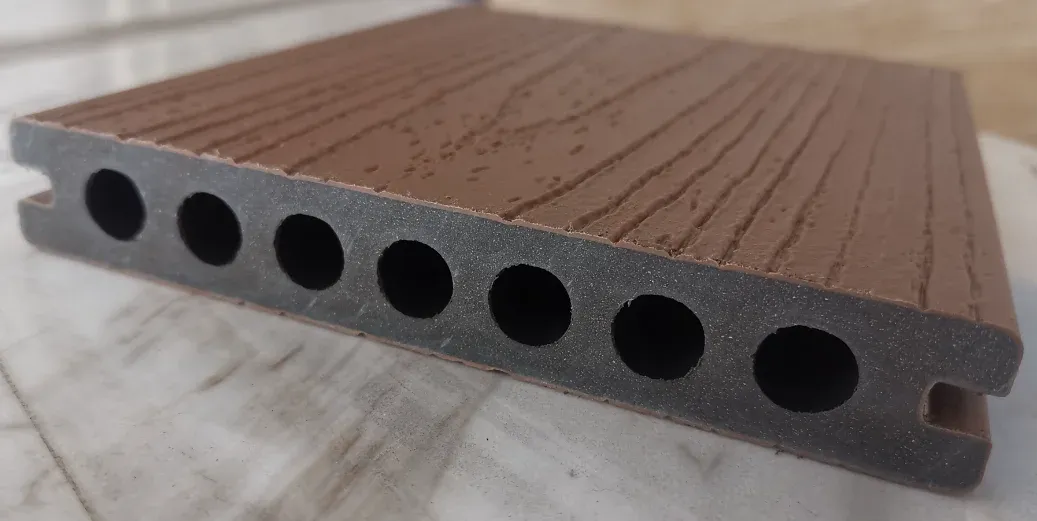
Co-extrusion WPC decking is a wood-plastic composite board produced with a co-extruded protective layer bonded over the core. In a single production pass, the board gains a polymer shell around a WPC core, which changes how the surface handles weather, dirt and day-to-day use compared with an uncapped traditional board. It is the technology behind what the industry often calls "capped" or "armored" decking. "Capped" is a common industry shorthand; MEISEN's catalog term is a co-extruded protective layer.
The Two Parts of a Co-extruded Board
The core is the WPC structure you would find in a traditional profile: wood fiber, HDPE and functional additives, formed as a hollow or solid profile that carries the load and holds the fixing system.
The protective layer is a polymer skin extruded around that core in the same process. Because the layer and the core bond during extrusion - not glued on afterwards - the shell wraps the board continuously, including the grooves. MEISEN describes this in its catalog as a co-extruded protective layer over the core, offered for residential and commercial decking.
General industry note: formulations of cap layers vary by manufacturer; ask for the technical documentation behind any board you are evaluating.
What the Capped Surface Changes
The cap is what separates co-extrusion decking from traditional WPC in daily use:
- The walking surface is the polymer layer, not exposed wood-plastic composite.
- Color and grain sit in the shell, so boards from the same production line show a consistent tone.
- Cleaning is a wash-and-go routine; there is no wood fiber at the surface to raise or splinter.
What the cap does not change: the board is still a profile that needs a correct substructure, correct fixing and realistic expectations about outdoor surfaces. A capped board is not a maintenance-free guarantee - it is a different surface system.
Grain Patterns and the 10-Color System
Co-extrusion lines carry their own color system. MEISEN's co-extrusion range uses ten standard colors coded B-001 to B-006 and Y-001 to Y-004 - from B-001 Charcoal and B-005 Teak to Y-001 Sky Blue and Y-004 Redwood. Custom colors are available on request, and as with any color selection, samples should be checked in project lighting before large orders.
Profile Options: Hollow and Solid
Co-extrusion decking comes in both structures:
- Hollow profiles such as GJ145K24 (145 x 24 mm) and GJ138K22 (138 x 22 mm) - the common choice for residential and commercial decks, fixed with hidden fasteners on a joist substructure.
- Solid profiles such as GJ145S24 (145 x 24 mm) and GJ105S18 (105 x 18 mm) - used where a project prefers a solid section.
The line also includes matching trims, such as L-style edge covers, so decks finish with the same capped surface.
Where Co-extrusion Decking Fits
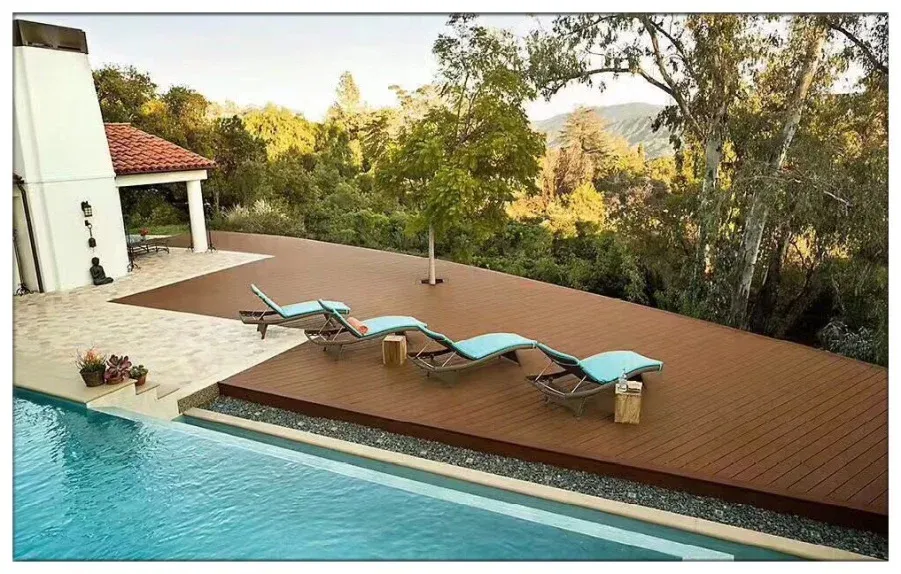
MEISEN positions its co-extrusion line for residential and commercial decking. In practice that spans private decks, shared walkways, poolside areas and commercial outdoor floors where a defined color system and a capped surface matter to the specification. For villas and landscape projects where a deep wood texture is the priority, the 3D embossed line is the alternative to compare.
Questions to Ask Before Specifying
- Which grain patterns are available on the profile width I need?
- What does the protective layer formulation cover - and what documentation supports it?
- How are boards fixed on my substructure type?
- Which color codes match my project palette, and can I get samples?
These questions apply to any co-extrusion supplier, not only to MEISEN.
FAQ
Is co-extrusion WPC the same as traditional WPC? No. Traditional WPC is a single-material profile; co-extrusion adds a protective polymer layer over the core during extrusion. The surface you walk on is different.
Is the core still WPC? Yes. The core remains wood fiber, HDPE and functional additives; the cap is bonded around it.
What colors are available? MEISEN's co-extrusion line uses ten standard colors (B-001 to B-006, Y-001 to Y-004) with custom colors available on request.
How is it installed? Hollow profiles use hidden fastener installation with clips on a joist substructure; clips, joists and accessories are supplied per project.
Does the cap make it indestructible? No. It is a surface system with different behavior, not a no-maintenance promise. Ask for technical documentation and treat the deck with normal outdoor care.
Talk to MEISEN About Capped Decking
Need help selecting a co-extrusion profile, grain or color? Contact MEISEN with your application, target market and estimated quantity.